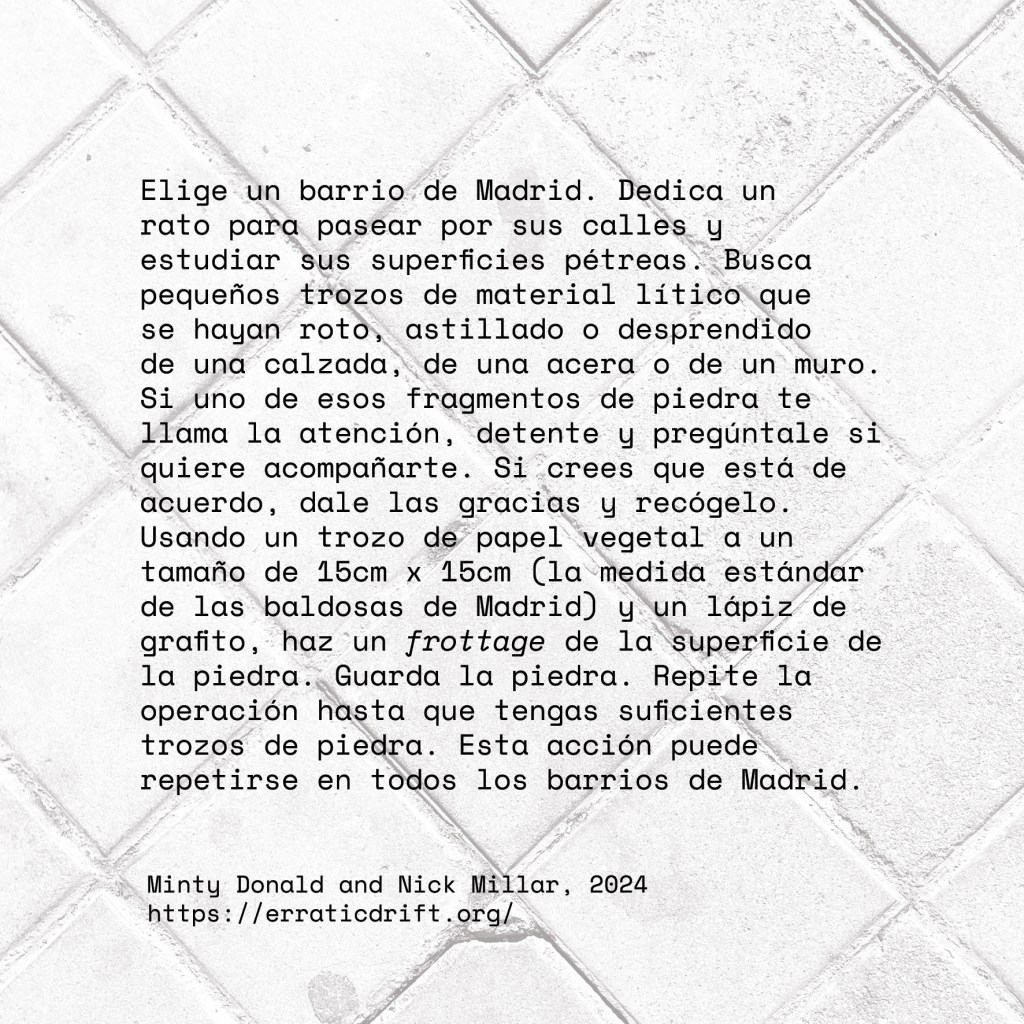
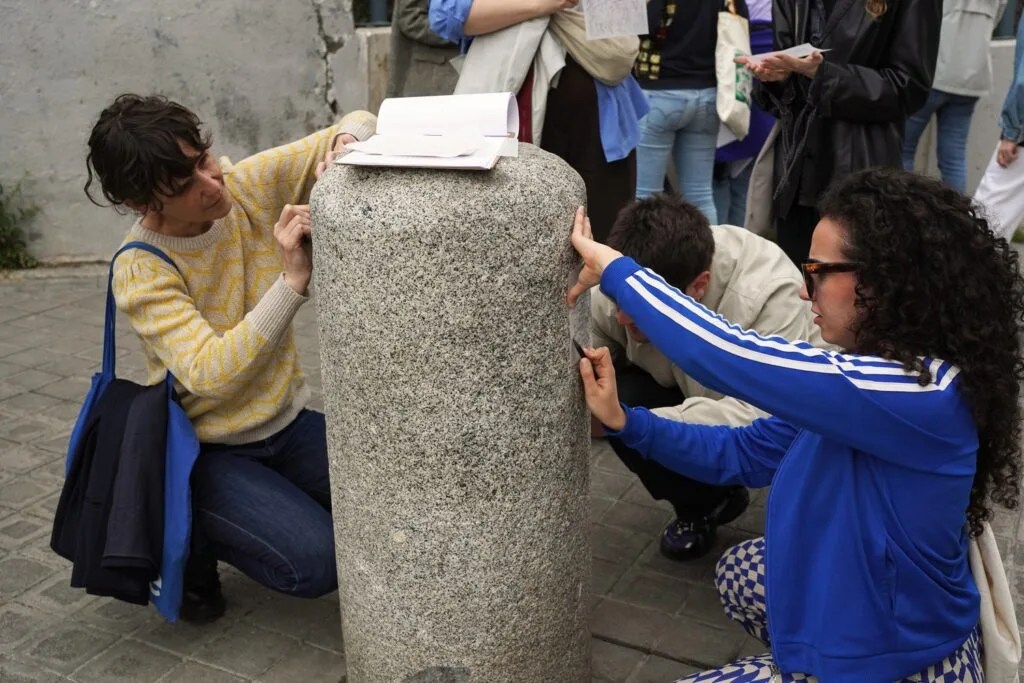
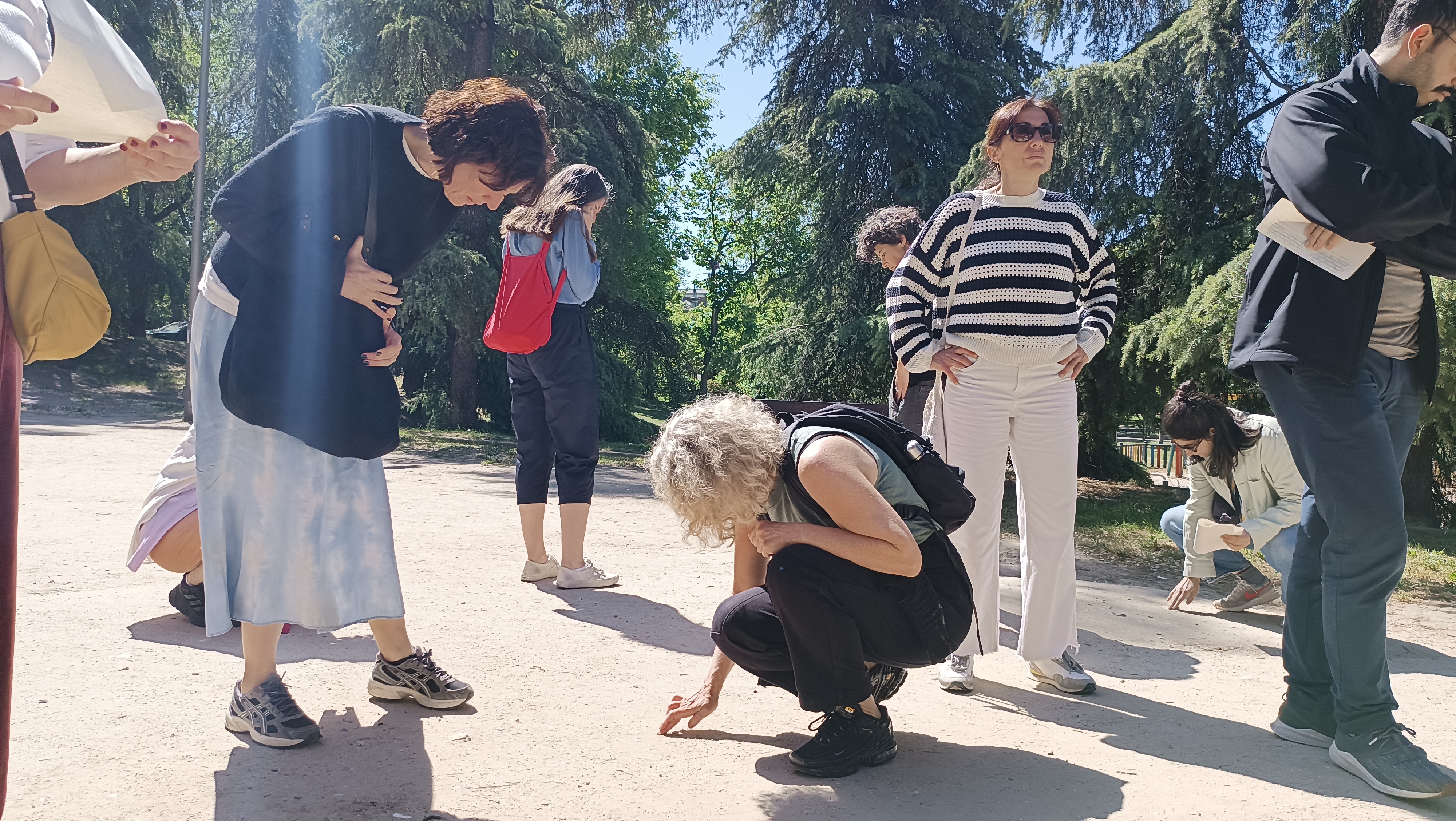
Choose a district of Madrid. Spend some time walking its streets and studying its stony surfaces. Look out for small pieces of lithic material that have broken or chipped or flaked from a road, pavement, or wall. If one of these fragments of stone catches your attention, stop, and ask it if it will come with you. If you think it has agreed, thank the fragment, and pick it up. Using a piece of tracing paper (torn to 15cm x 15cm – the size of Madrid’s standard paving tiles) and a graphite pencil, make a rubbing of the surface of the stone. Keep the stone. Repeat until you have enough pieces of stone. This action can be repeated in all the districts of Madrid.
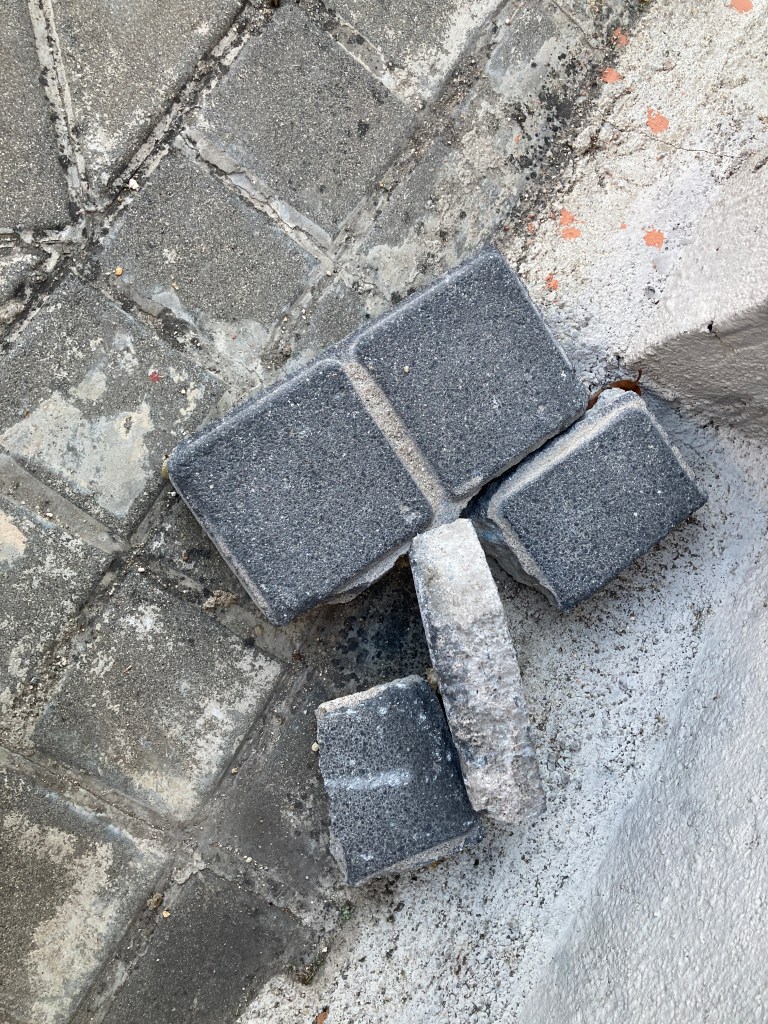
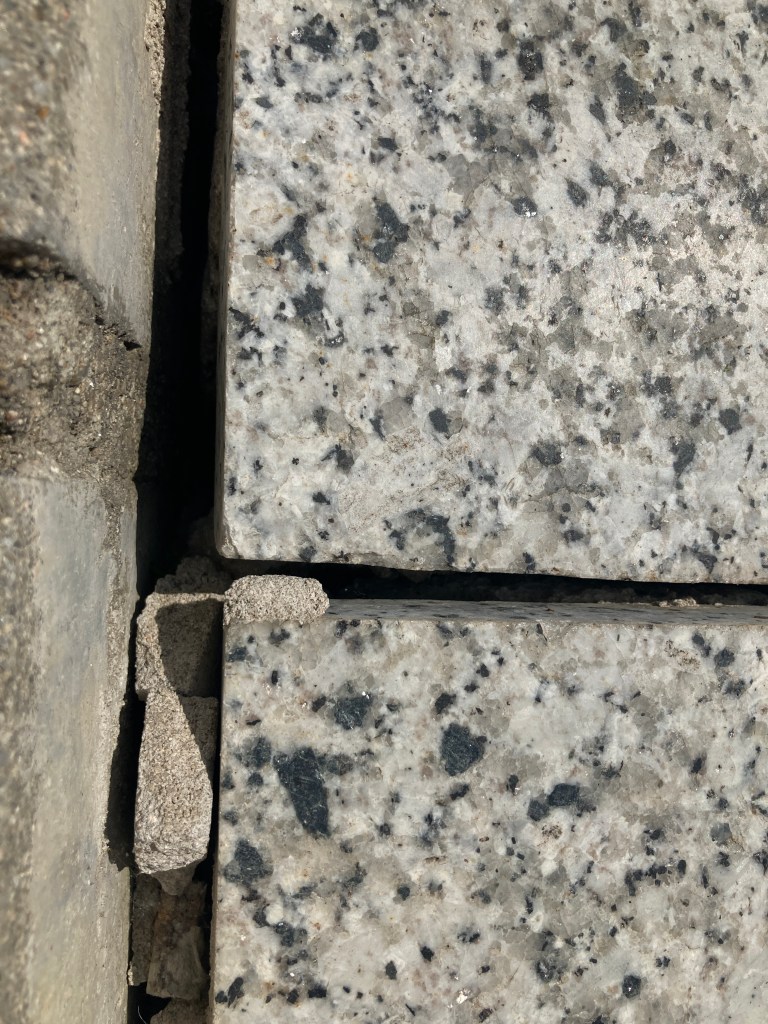
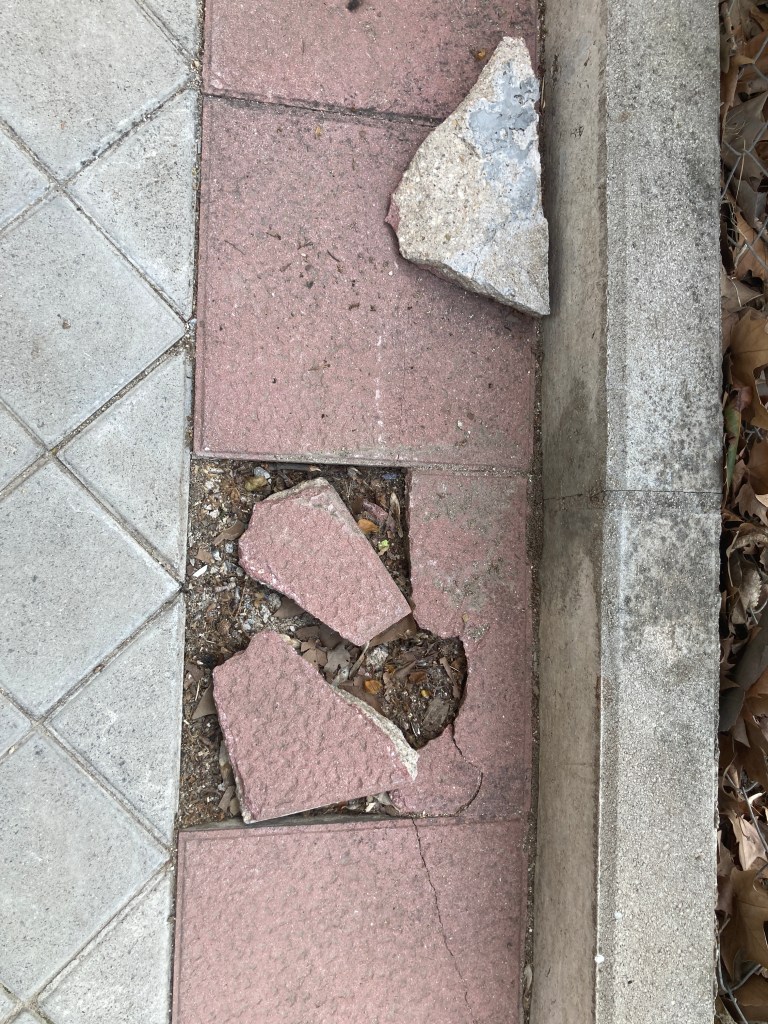
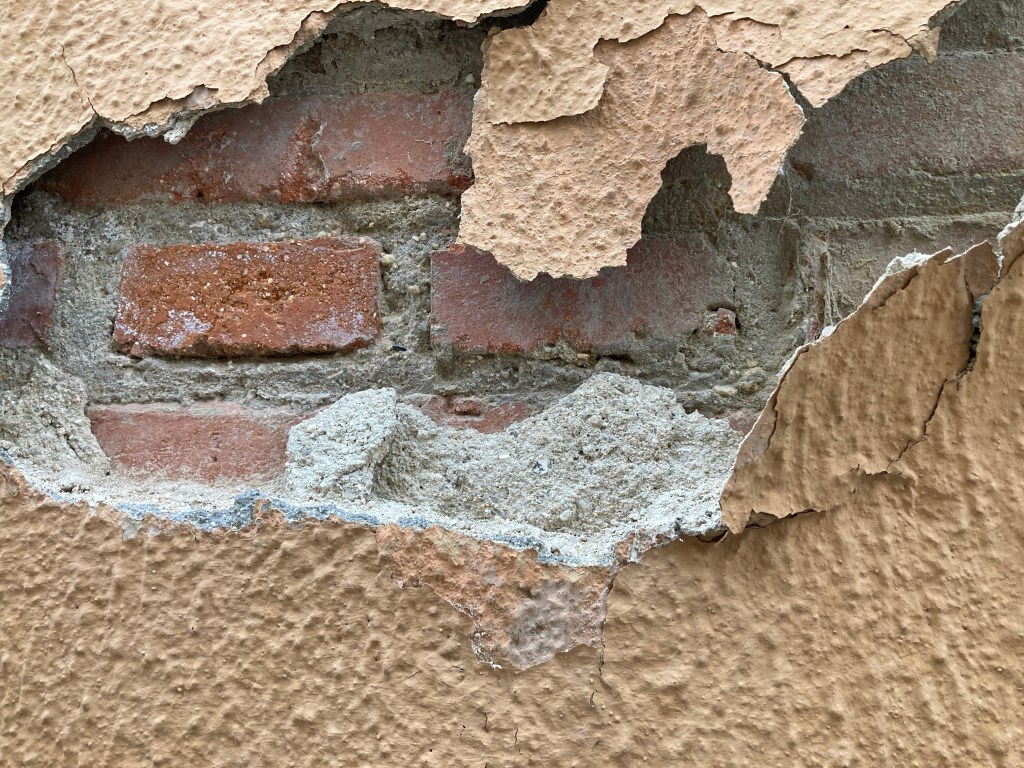
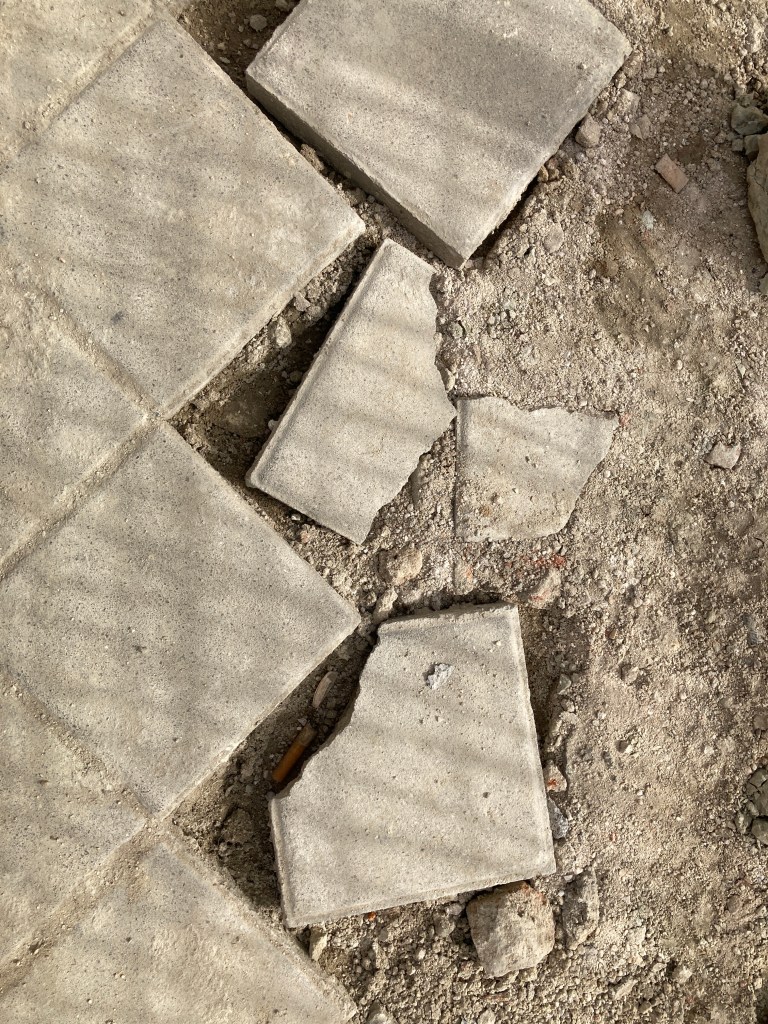
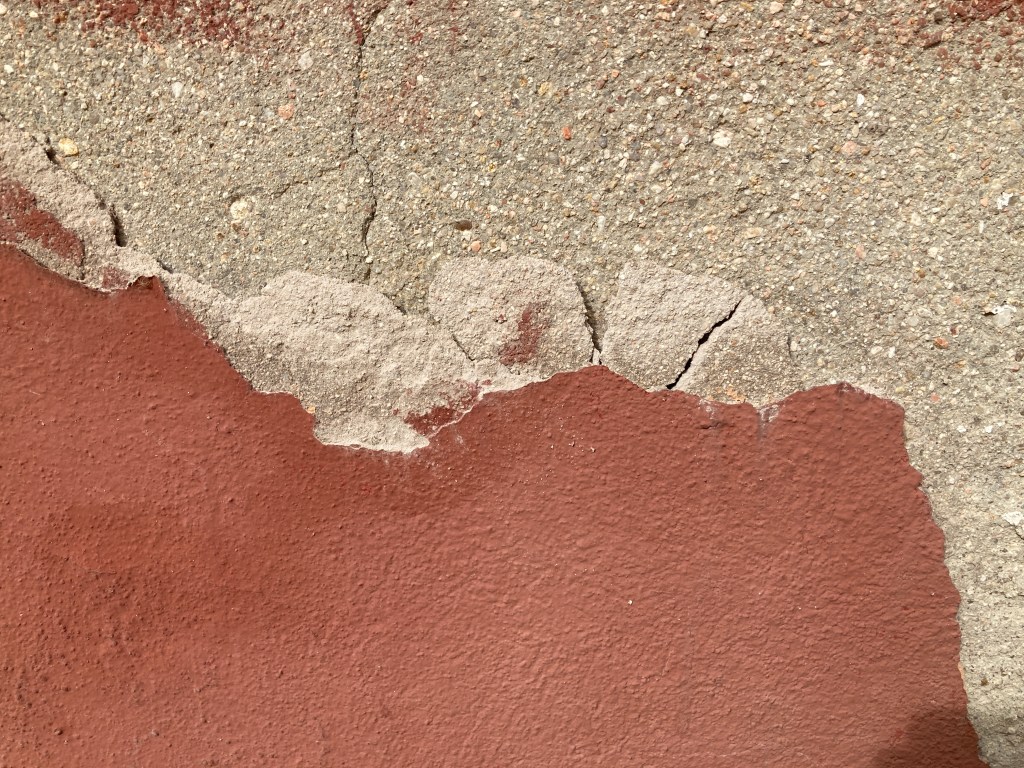
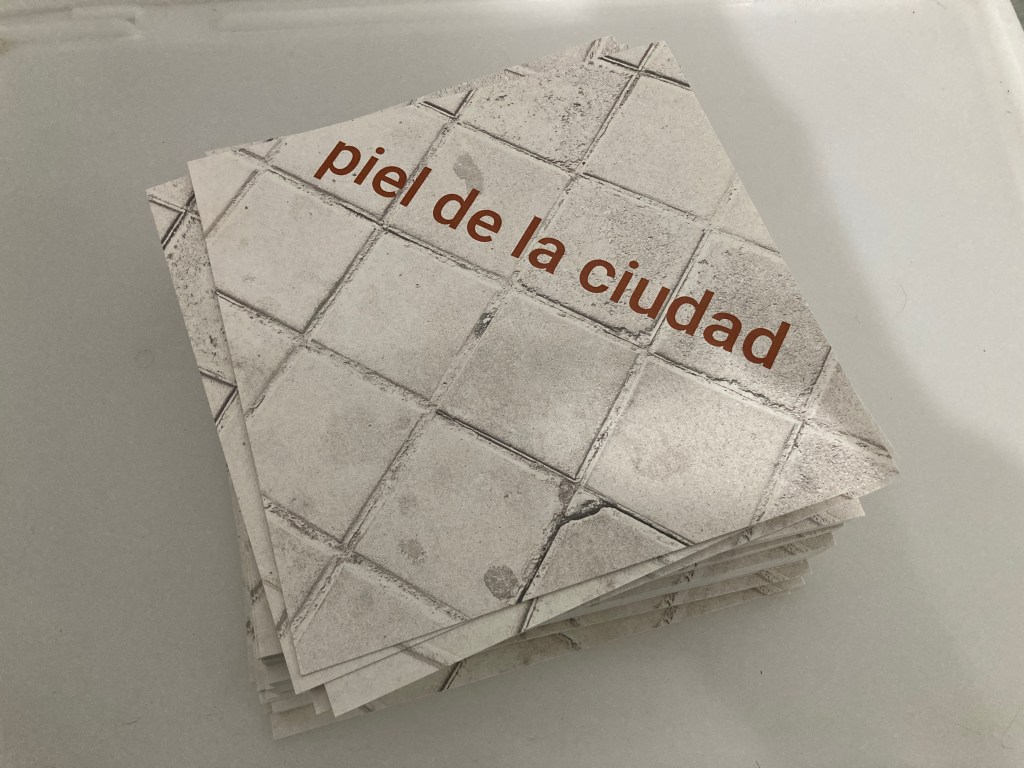
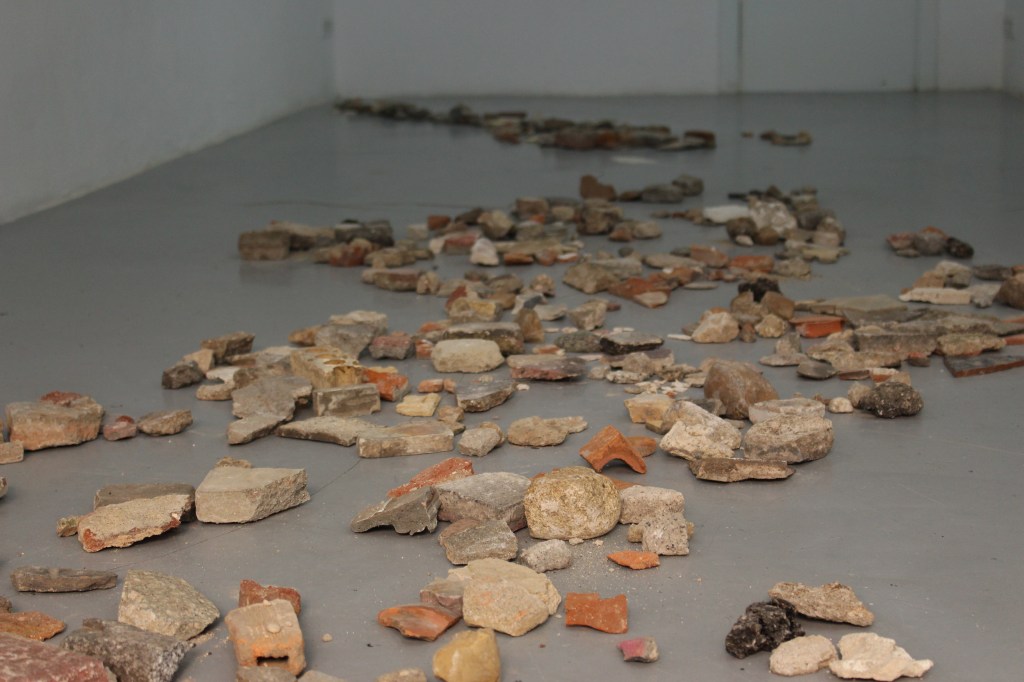
Se recogieron fragmentos de material lítico en cuatro distritos de Madrid: Carabanchel, Usera, Ciudad Lineal y Vallecas. Los fragmentos se instalaron en el suelo de la galería Ramón Luján 78, para crear un mapa lítico de la ciudad.
Fragments of lithic material were collected from four districts in Madrid: Carabanchel, Usera, Ciudad Lineal and Vallecas. The fragments were installed on the floor of Ramón Luján 78 gallery, to make a lithic map of the city.
Piel de la Ciudad, Ramón Luján 78, April 2024
Textos de la expositión/Exhibition texts
Piel de la Ciudad #1 – Piel
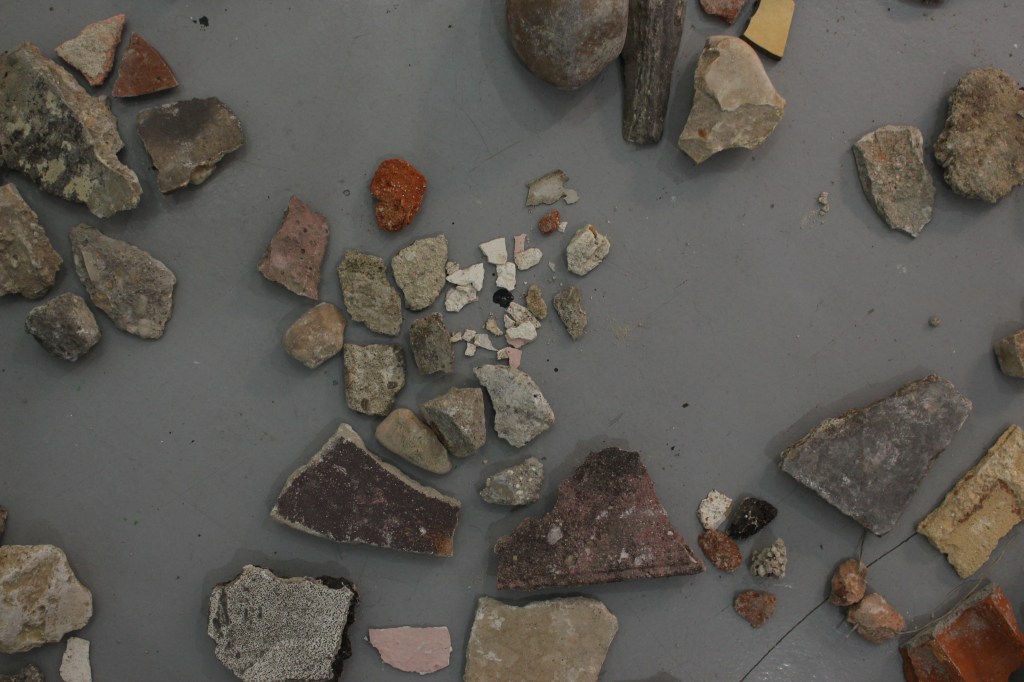
Hemos estado pensando en los materiales duros y pétreos que forman la “piel” de Madrid. Hemos estado estudiando aceras, calles, bordillos y muros; asfalto, baldosas, ladrillos, granito, piedra caliza y cemento. Hemos notado cómo las superficies líticas se agrietan, se ampollan, se despellejan y se quiebran; cómo son parcheadas y reemplazadas; cómo están siempre cambiando, siempre en movimiento. Hemos estado pensando en lo que significa extender una capa lítica sobre la tierra, creando una barrera pétrea entre nosotros y el “afuera”. Nos preguntamos ¿qué tan gruesa es la piel de una ciudad? ¿Qué guarda y qué mantiene fuera? ¿Qué la atraviesa? ¿Qué cosas oculta?
Piel de la Ciudad #1 – Skin
We have been thinking about the hard, stony materials that form the ‘skin’ of Madrid. We have been studying pavements, roads, kerbs, and walls; asphalt, tiles, bricks, granite, limestone, rubble, and cement. We have noticed how lithic surfaces crack, peel, chip, and rupture; how they are patched and replaced; how they are always changing and always on the move. We have been thinking about what it means to extend a lithic layer over the earth, to make stony barriers between ourselves and the ‘outside’. We wonder, how thick is the skin of a city? What does it keep out or keep in? What passes through it? What does it hide?
Piel de la Ciudad #2 – Bloques Erráticos
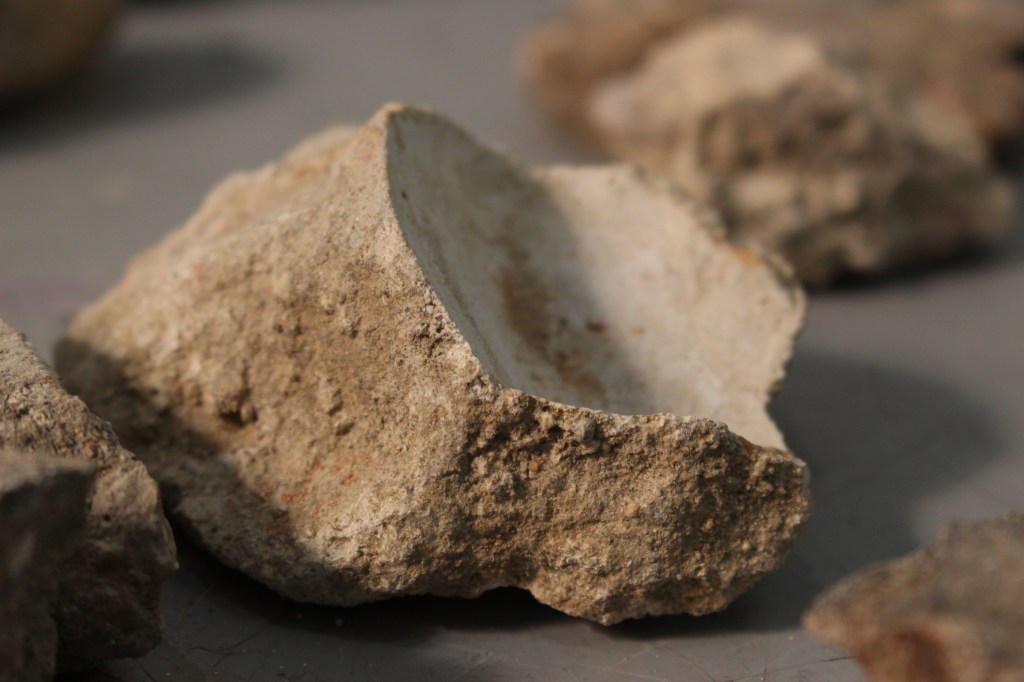
No somos de aquí. Si fuéramos rocas o piedras (y lo somos, en parte, por nuestros huesos y dientes) seríamos bloques erráticos. Los erráticos son rocas que no están compuestas del mismo material que el lecho rocoso local. Son rocas que han viajado desde algún otro lugar, a menudo transportadas por hielo glaciar.
La geógrafa, Doreen Massey, escribió sobre un bloque errático alojado en el río Elba, en Hamburgo (Alemania). El errático fue usado en una campaña para promover la aceptación de inmigrantes en la ciudad. Doreen Massey dijo: “No se trata en absoluto de una roca “local”. ¿O sí? ¿Cuánto tiempo hay que llevar aquí para ser local?”
Como erráticos quizá nos sintamos un poco fuera de lugar. Creemos que tal vez no tenemos el derecho ni los conocimientos necesarios para hablar de cosas de la forma en la que lo harían quienes llevan aquí más tiempo que nosotros. Queremos saber más sobre este lugar. Nos preguntamos, ¿podemos llegar a conocer una ciudad a través de su piel pétrea?
Piel de la Ciudad #2 – Erratics
We are not from here. If we were rocks or stones (and we are, partly, in our bones and teeth) we would be erratics. Erratics are rocks that are not composed of the same material as the local bedrock. They are rocks that have travelled from somewhere else, often transported on glacial ice.
The geographer, Doreen Massey, wrote about an erratic lodged in the Elbe River in Hamburg, Germany. The erratic was used in a campaign to promote the acceptance of immigrants in the city. Doreen Massey said: ‘By no means, then, a ‘local’ boulder. Or is it? How long do you have to have been here to be local?’
As erratics we perhaps feel a little out of place. We feel, perhaps, that we don’t have the knowledge or authority to speak about things in the ways that people who have been here longer than us might do. We want to find out more about this place. We wonder, can we get to know a city through its stony skin?
Piel de la Ciudad #3 – Movimiento
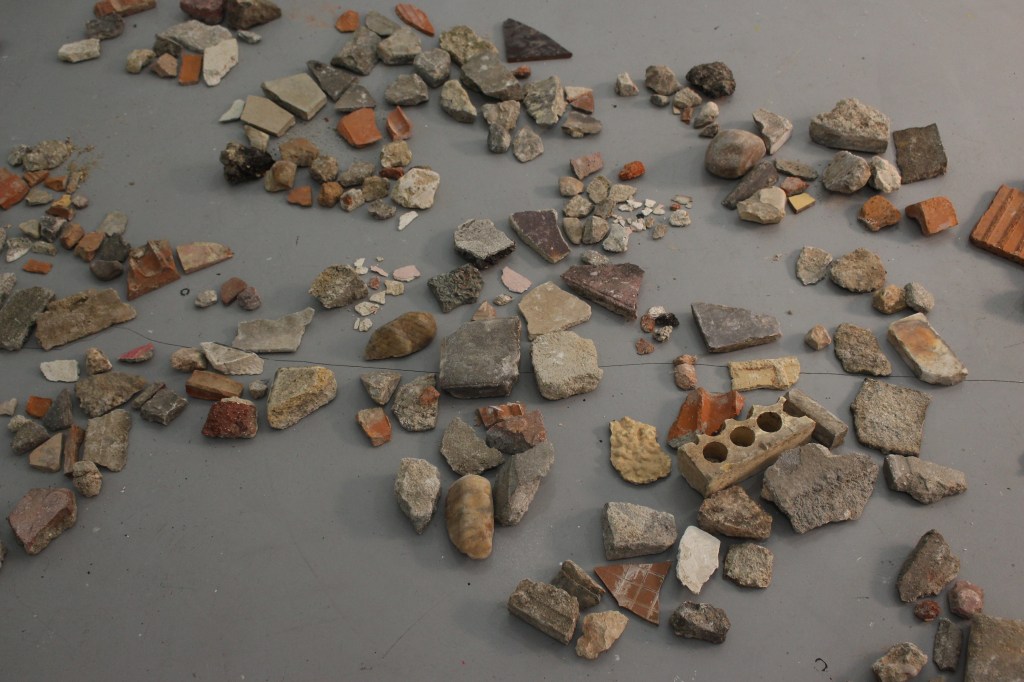
Hemos estado pensando en cómo, con el tiempo, todas las cosas se desplazan y cambian. Sobre cómo, al igual que nuestra piel (humana) se seca, se muere y se despelleja, la piel de una ciudad se desprende y se convierte en polvo. Hemos estado pensando en cómo los monumentos líticos, los edificios comerciales, gubernamentales y residenciales, y la infraestructura pétrea de las calles y las aceras, se van deteriorando y volviéndose ruinas, desde el momento en que se construyen. Hemos estado pensando en los viajes de la materia pétrea: el limo y las piedrecitas que viajan con la corriente de un río; la arena, arrastrada por el viento, que forma playas y desiertos; las rocas movidas por fuerzas glaciares y volcánicas. Hemos estado pensando en las enormes cantidades de material lítico que los humanos mueven a través de la extracción y la construcción. Nos preguntamos si ¿una ciudad puede ser vista como una acumulación momentánea de materia? ¿Acaso las ciudades son una breve pausa dentro de un viaje lítico mucho más largo?
Piel de la Ciudad #3 – Movement
We have been thinking about movement and change. About how, over time, all things shift and drift. About how, just as our (human) skin dries, dies, and flakes, so too the skin of a city sheds and crumbles to dust. We’ve been thinking about how lithic monuments; edifices of commerce, government, and dwelling; and stony infrastructure of roads and pavements decay and ruin, from the moment they are built. We’ve been thinking about the journeys of stony matter: silt and pebbles travelling with the flow of a river, sand blown to form beaches and deserts, rocks moved by glacial and volcanic forces. We’ve been thinking about the vast quantities of lithic material moved through human extraction and construction. We wonder, can a city be understood as a momentary accumulation of matter? Are cities a brief pause in a far longer lithic journey?
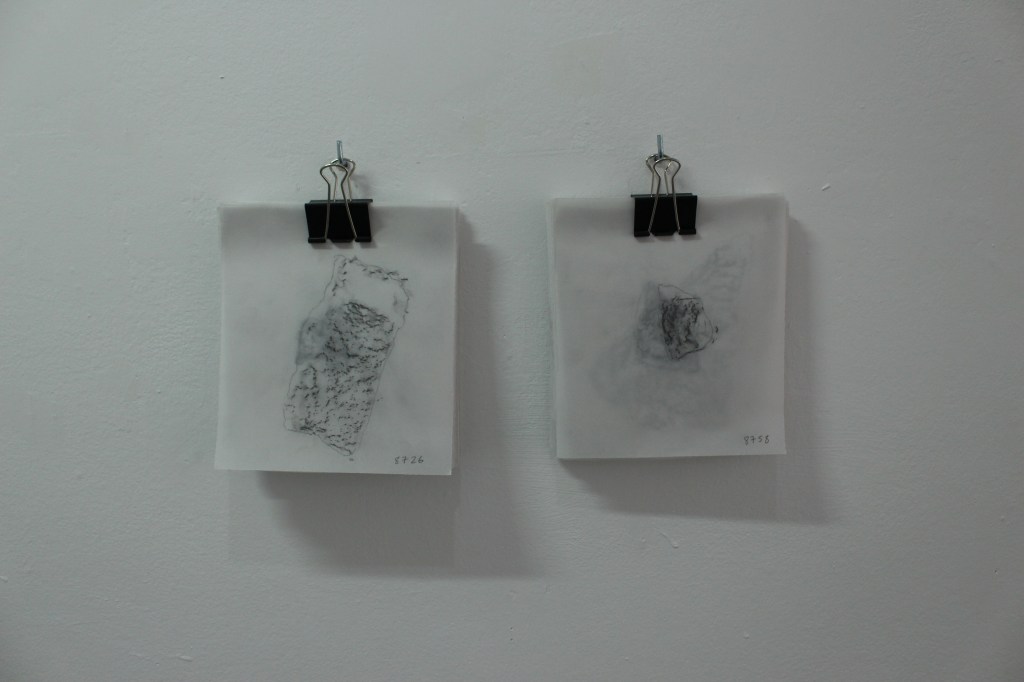

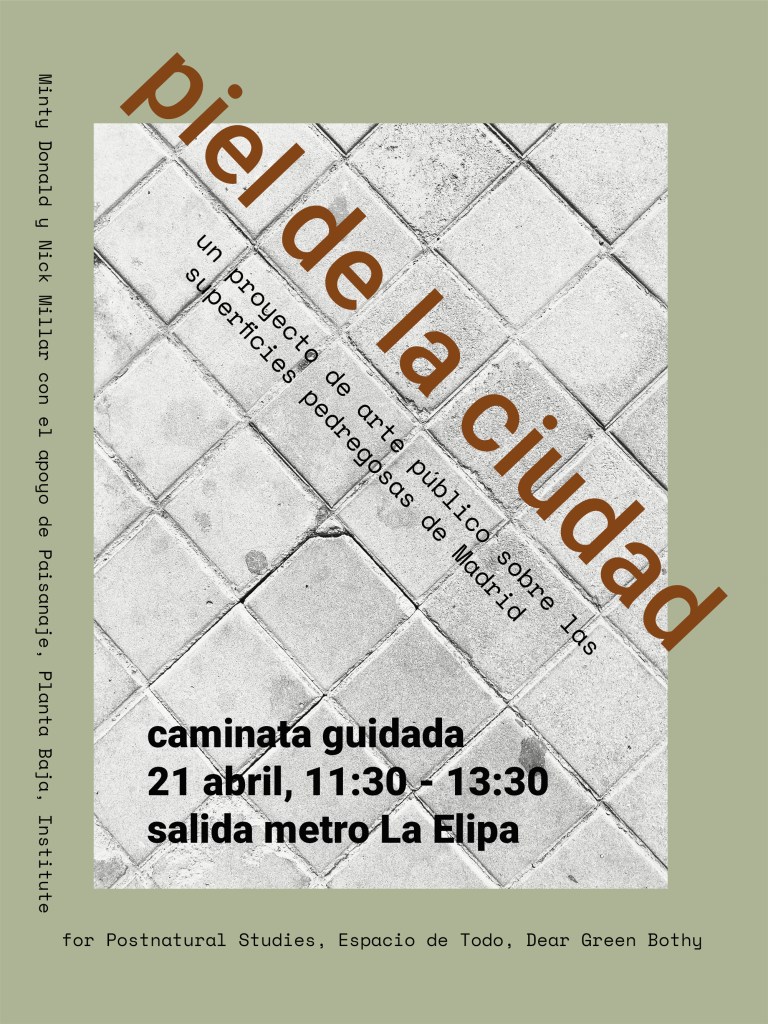
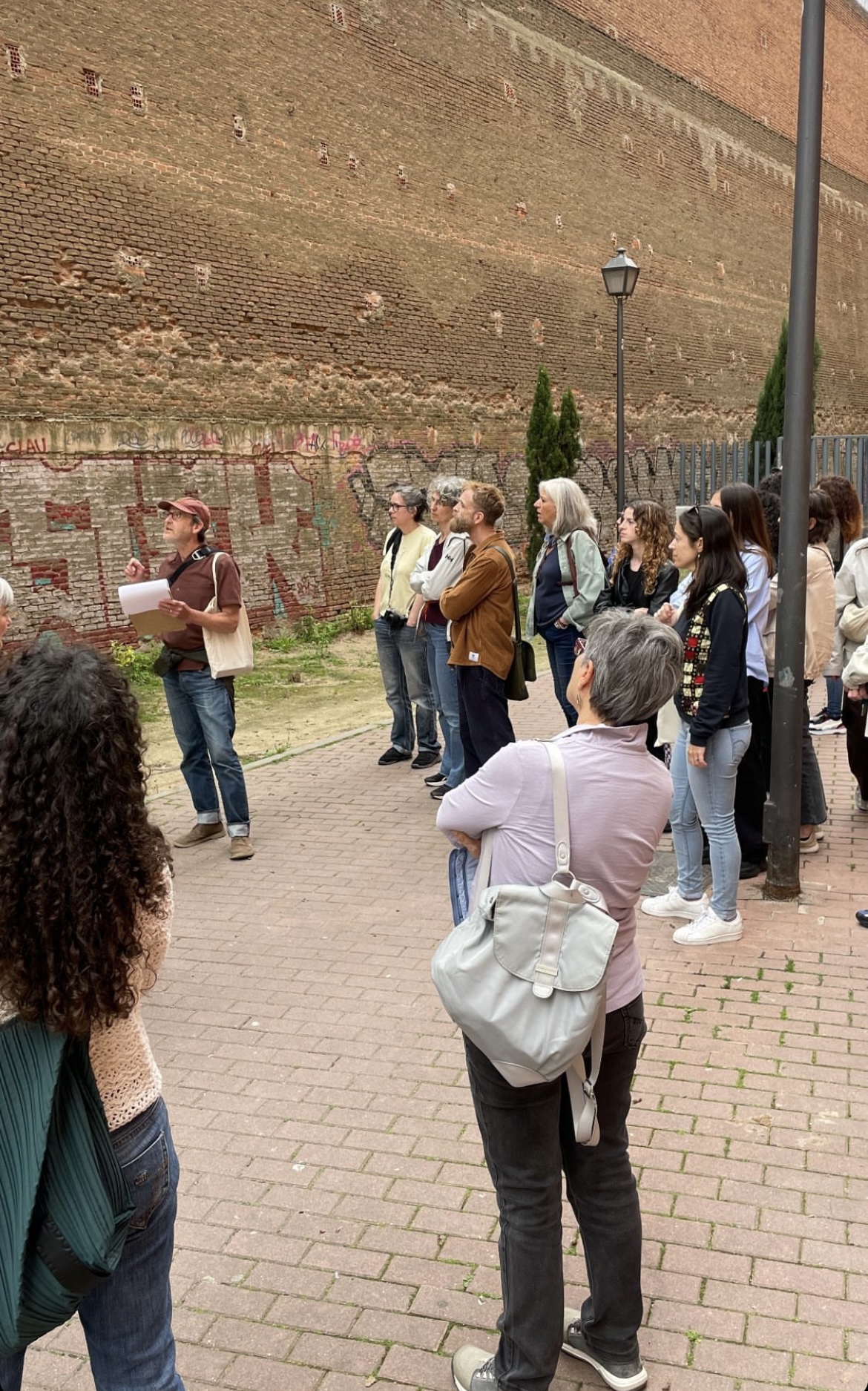
Dos caminatos performativos sobre las superficies pedregosas de Madrid: Carabanchel y Ciudad Lineal
Two performative walks about the stony surfaces of Madrid: Carabanchel and Ciudad Lineal

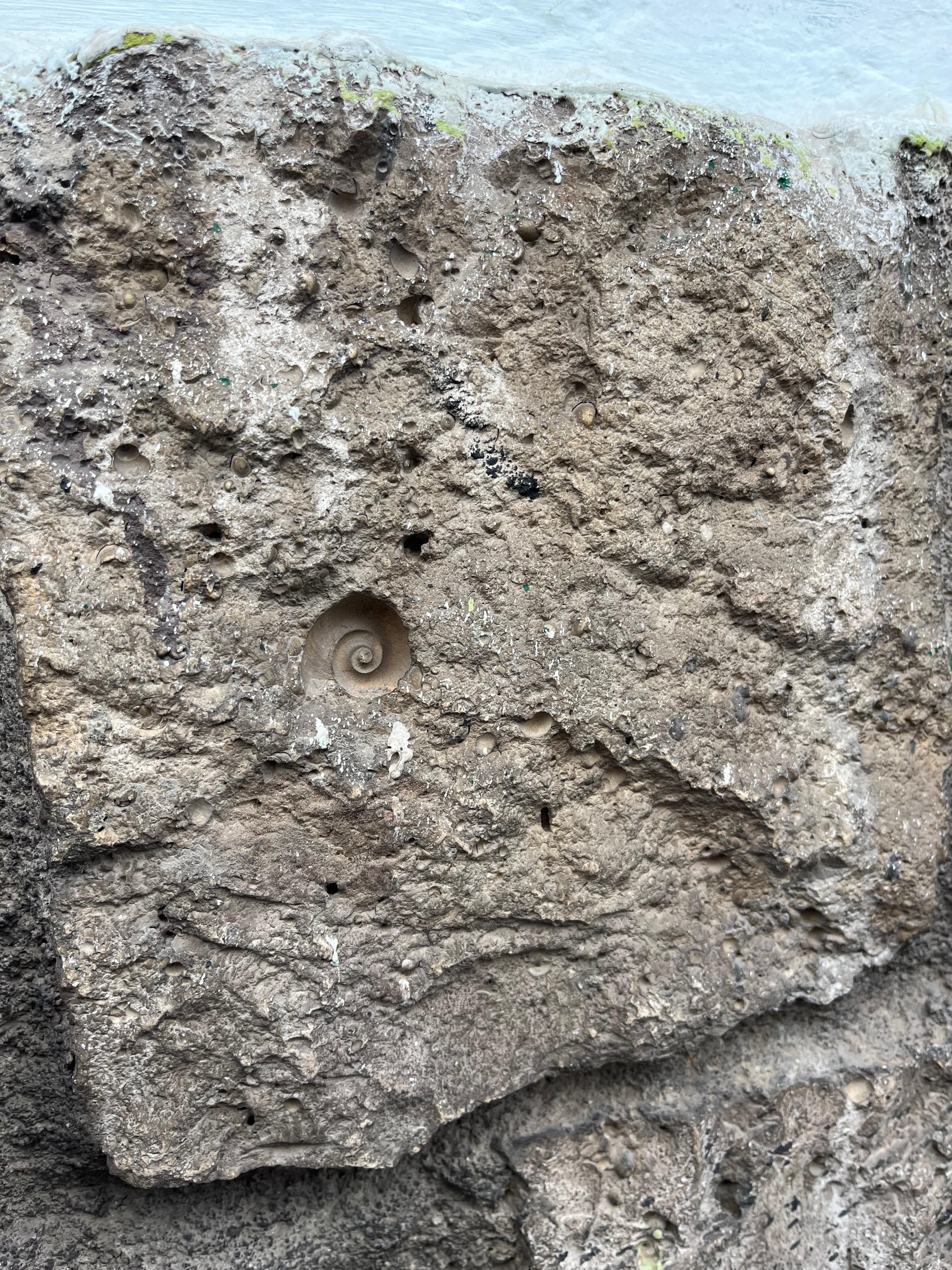
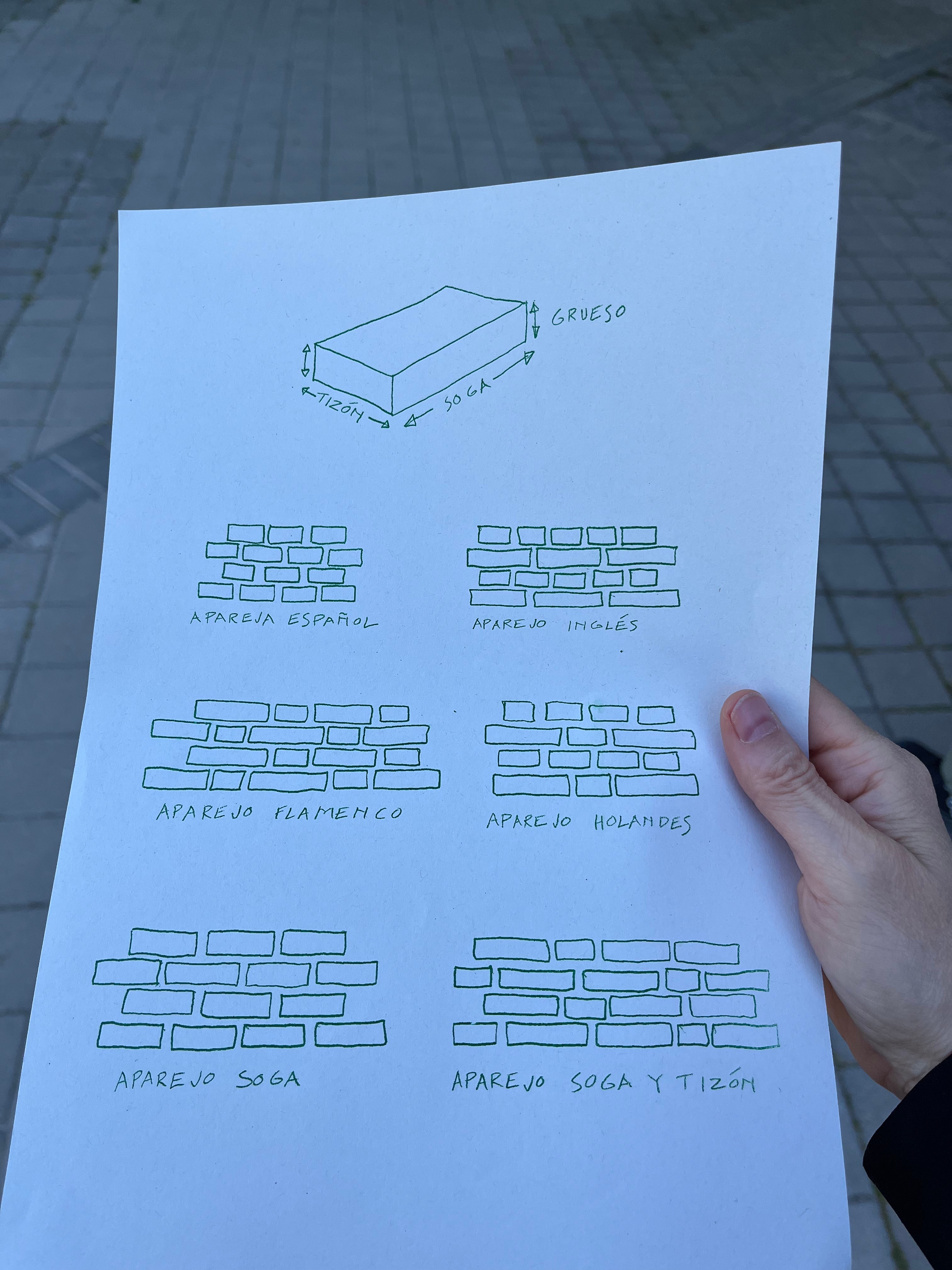

 Erratic Drift